




Bahiyya Sahli
Abstract
The profound technological transformations of the contemporary era have exerted a marked influence on educational theory and practice, particularly following the advent of generative artificial intelligence (AI); systems capable of producing novel, human-like creative outputs. Although this technological leap offers significant pedagogical opportunities, it simultaneously raises concerns regarding the preservation of learner identity. These concerns become especially salient in the case of the Muslim child, given that generative AI systems are largely developed within Western epistemological and axiological frameworks that propagate values and conceptual orientations potentially at odds with Islamic references. In light of this challenge, the present study investigates how generative AI-now a pervasive component of educational environments-may be pedagogically leveraged in the upbringing of Muslim children without compromising their identity. The central research problem is articulated as follows: By what mechanisms can the identity of the Muslim child be safeguarded from the ideological and cultural influences embedded in generative AI, while enabling its constructive and ethically appropriate use in learning contexts? Methodologically, the study adopts an integrated tripartite approach-descriptive, analytical, and comparative-to address this question. The findings demonstrate that Islamic educational philosophy offers a holistic and value-centered framework for the formation of the Muslim child's identity across cognitive, moral, spiritual, and social dimensions. Furthermore, the research concludes that generative AI can indeed be incorporated into child education without jeopardizing Islamic identity, provided that deliberate safeguards, evaluative criteria, and pedagogical protocols are implemented to ensure that AI functions as a culturally aligned instrument for strengthening-rather than destabilizing-the child's Islamic identity.

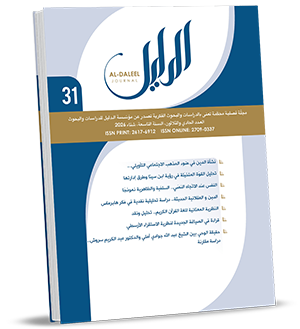

مؤسّسة الدليل للدراسات والبحوث هي مؤسّسةٌ تحقيقيّةٌ تعليميّةٌ تعنى بتحقيق الفكر الإسلاميّ .
 مؤسسة الدليل